SMHUB NanoMR.
Two radios. One Linux hub.
The SMHUB Nano, doubled. A second dedicated Zigbee/Thread radio joins the first, so you can run two independent Zigbee or Thread networks at once — from the same compact, fanless Linux hub that hosts Zigbee2MQTT, Matterbridge, Node-RED and more, all local.
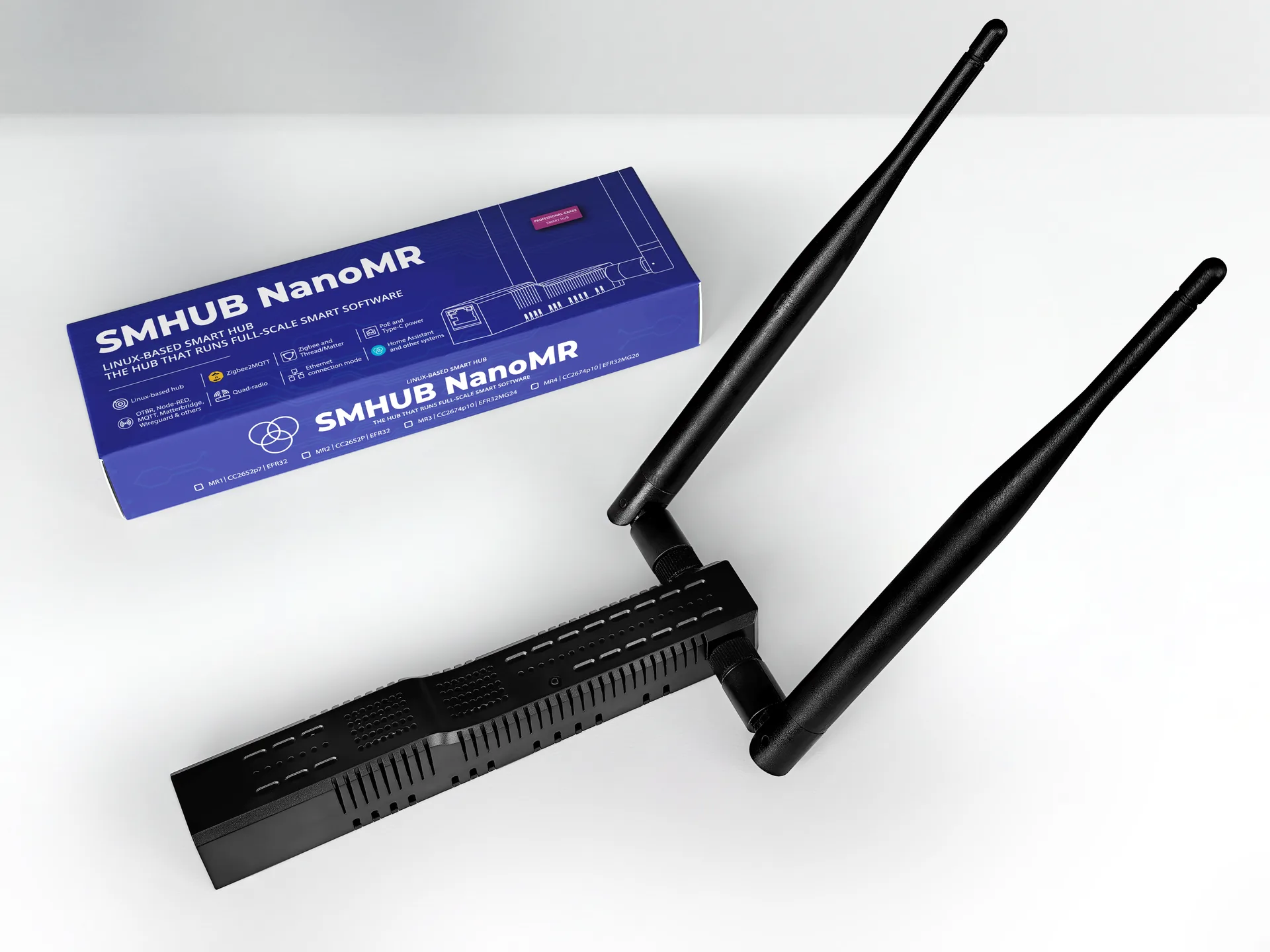
A tiny hub with two radios.
SMHUB NanoMR combines two dedicated Zigbee/Thread radios, a real Linux OS and local apps in one compact device — a full smart-home brain, a Matter bridge, or a dual-radio coordinator.
 Linux-based hubSMHUB-OSRuns real apps locally — not a locked-down appliance
 Two Zigbee/Thread radiosQuad-radioTwo dedicated SoCs — run two networks at once
 Wi-Fi 62.4 & 5 GHzPlus 1× RJ45 Ethernet 10/100
 Bluetooth 5.0Integrated BLEOn-board wireless
 USB expansionUSB host modeAdd Z-Wave, extra radios or an LTE modem
 Z-Wave readyvia USB dongleRun Z-Wave JS UI with a ZWA-2 stick
 WireGuard VPNSecure remoteReach your hub safely from anywhere
 OTA updatesSystem & appsUpdate from the web UI
 Web consoleLocal-firstFull control in the browser — no cloud account
One radio, or two.
The two hubs are identical but for their radios — exactly the step up from SLZB-06x to SLZB-MRx.
One hub, your way.
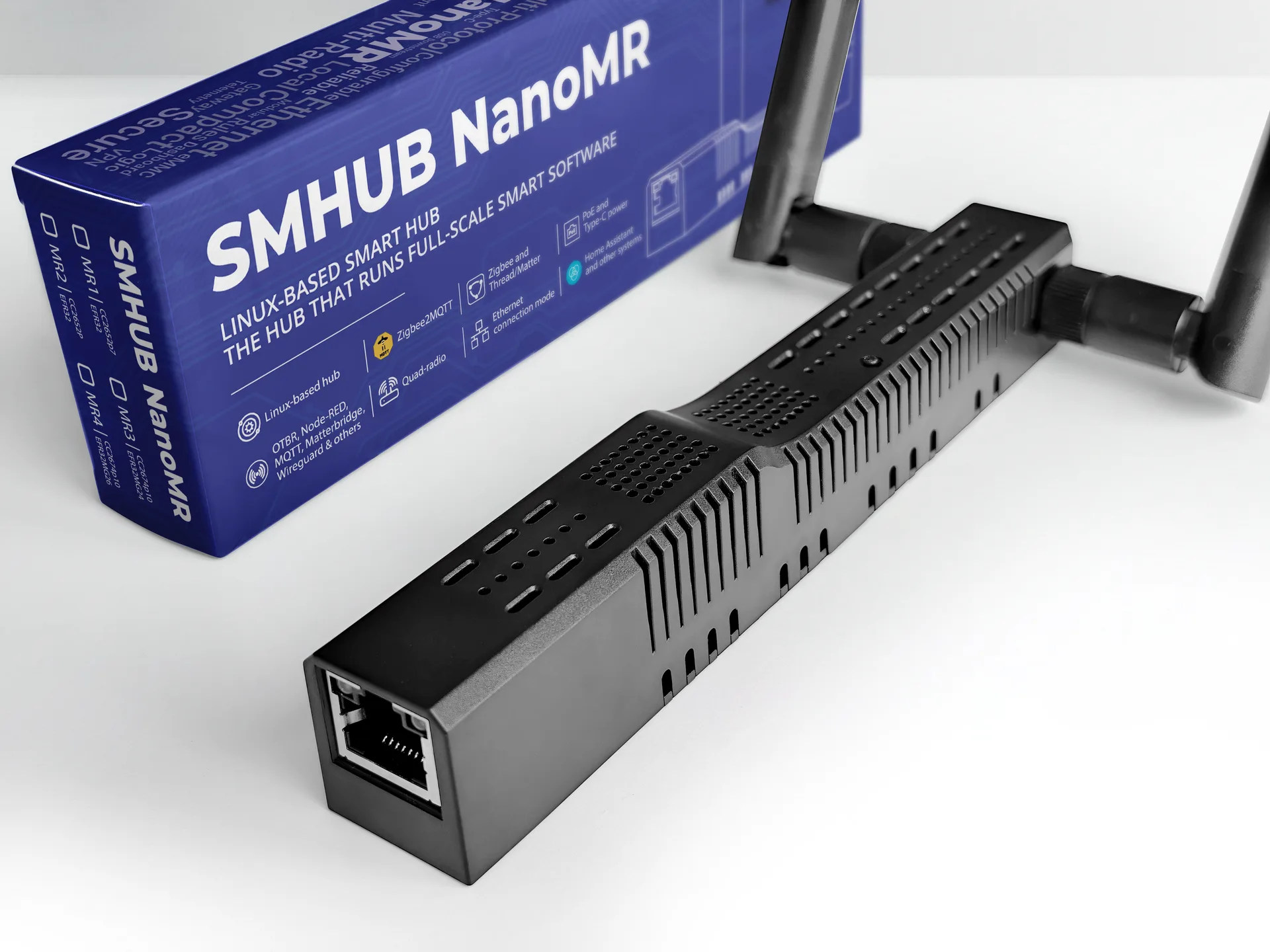
See it up close.
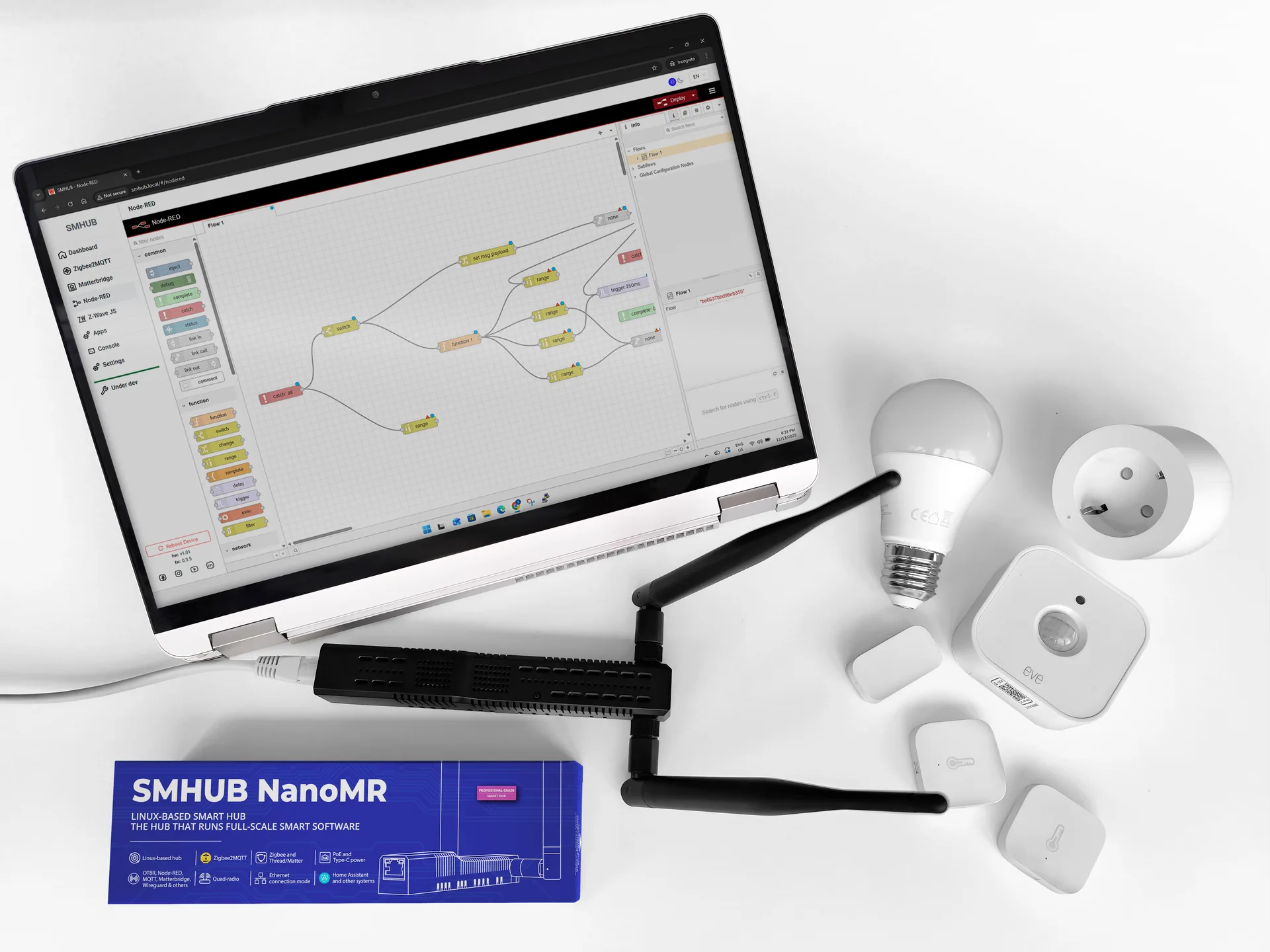
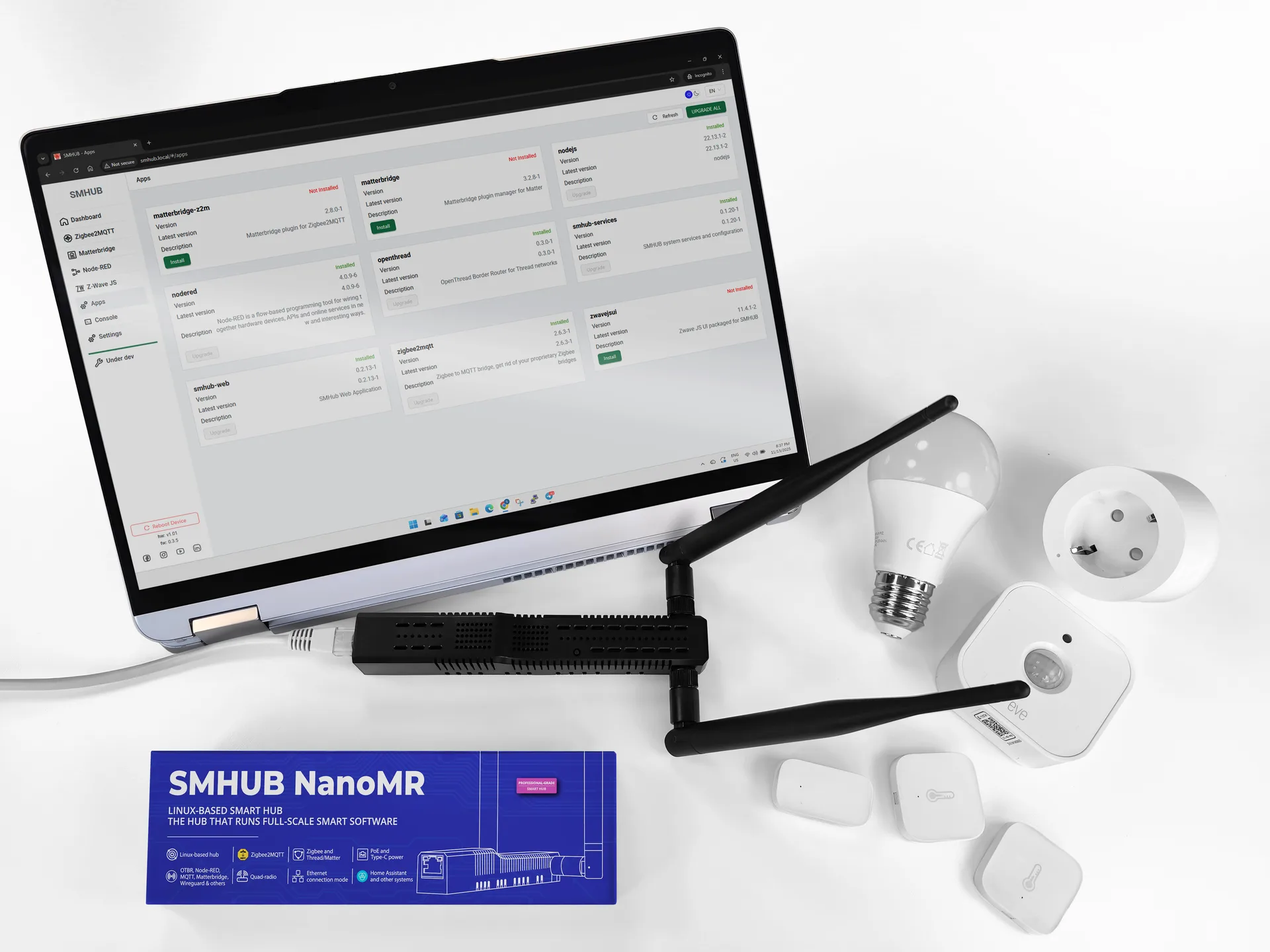
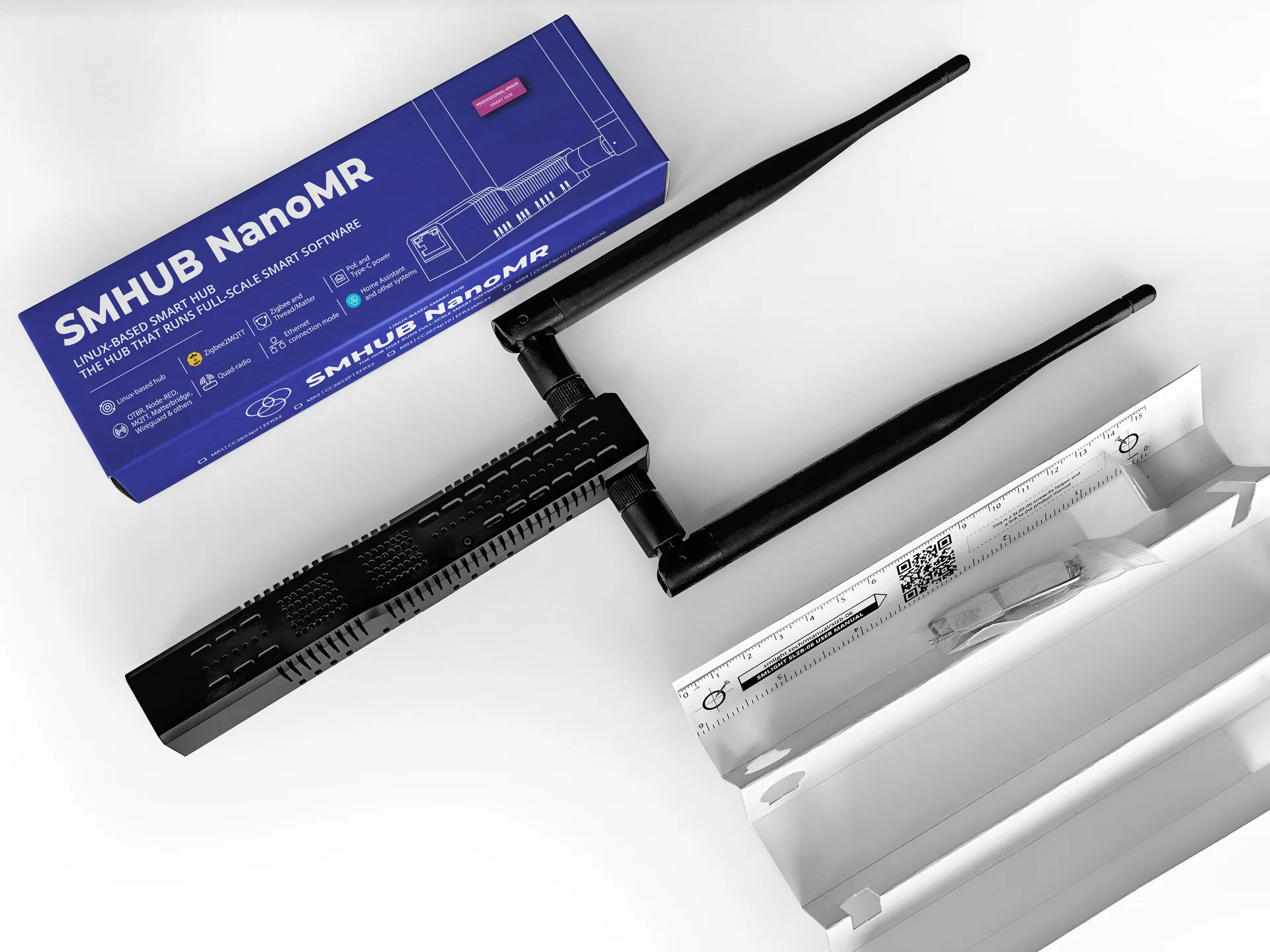
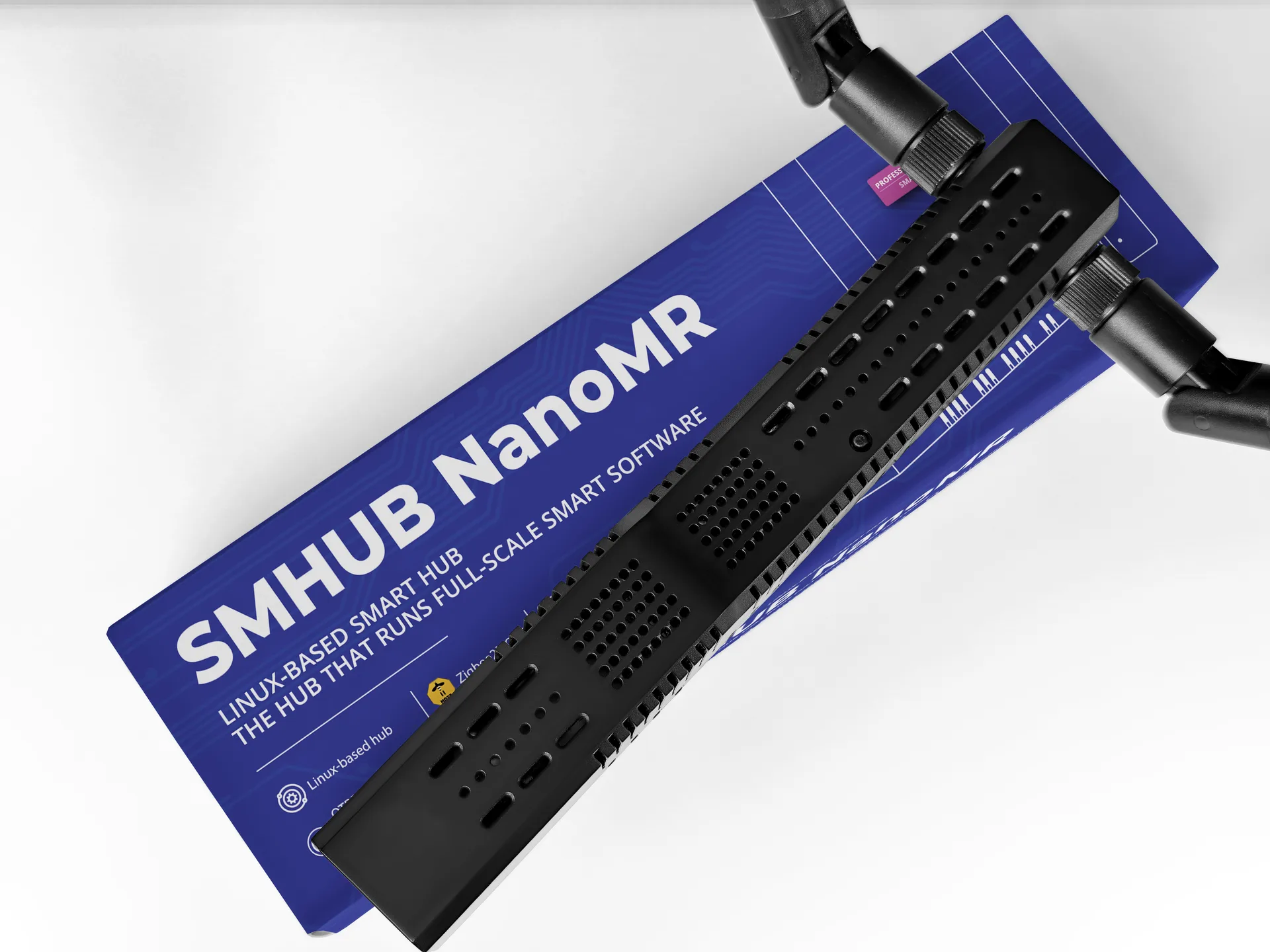
A full smart-home stack, running locally.
Each capability runs as a local app on the hub. Here's what you can do — and how the pieces connect.
The NanoMR carries two dedicated Zigbee/Thread SoCs (five pairings, MR1–MR4 and MR6). Run two Zigbee networks on separate channels to spread the load of a large mesh, keep a rock-solid production network apart from one you’re tinkering with, or run Zigbee on one radio and a Thread border router on the other — simultaneously, on one hub.
- Split a big mesh across two channels
- Separate a stable network from an experimental one
- Zigbee on radio 1, Thread on radio 2 — at the same time
Pair your Zigbee devices to the NanoMR and run Zigbee2MQTT on the device itself — one instance per radio if you like — then connect it to Home Assistant. Connect directly to Home Assistant’s MQTT broker for a fast, simple setup, or run the NanoMR’s own broker in bridge mode so Zigbee2MQTT keeps running and reconnecting under almost any circumstances.
- One Zigbee2MQTT instance per radio
- MQTT bridge mode — practically unstoppable
- A drop-in dual Zigbee coordinator when you prefer
Matterbridge runs directly on the NanoMR, reads the devices paired through Zigbee2MQTT and exposes them as Matter devices on your local network. Scan the pairing QR code in your Matter app and your Zigbee gear shows up in ecosystems that don’t normally speak Zigbee.
- Use Zigbee devices in Google Home, Apple Home or Alexa
- Mix Zigbee and Matter devices in one setup
- Cross-ecosystem compatibility, all local
Node-RED runs as a local app on the NanoMR. It reacts to events from Zigbee2MQTT, MQTT, timers or other local services and sends commands back — so your logic executes on the device, with low latency and no cloud dependency. It keeps working even if Home Assistant is down.
- Run automations without Home Assistant
- Fast-response rules for lights, sensors and buttons
- Combine both Zigbee networks, timers and external APIs
With two radios, the NanoMR can dedicate one to a Thread Border Router (OTBR) while the other keeps running Zigbee — bridging Thread and IP networks so Thread and Matter-over-Thread devices talk to Home Assistant, without giving up your Zigbee mesh. Add several units as separate border routers to one Home Assistant instance and they form a single Thread mesh across floors, buildings or sites.
- Zigbee and Thread at the same time
- Enables Matter-over-Thread devices
- Multiple border routers → one big, reliable mesh
The NanoMR is built to scale. Connect several units to a single Home Assistant instance — or to another SMHUB acting as the master — even across different networks or locations via WireGuard. Give each radio a unique Zigbee2MQTT base topic and grow coverage without adding complexity to the controller.
- Cover a large home, office or multiple buildings
- Remote sites joined over an encrypted tunnel
- One control plane — every device in one UI
With USB Host mode and a powered USB hub, the NanoMR takes Z-Wave sticks, extra radios, 4G/LTE modems and other USB peripherals on top of its two built-in radios. Install Z-Wave JS UI, plug in a ZWA-2 dongle, and run a full Z-Wave network locally — then expose it to Home Assistant.
- Run Z-Wave locally with a ZWA-2 dongle
- Add a third radio or an LTE modem
- Mixed-protocol setups on one device
Local-first, by design.
Every number.
| Core system | Value |
|---|---|
| CPU | 2 cores · 1 GHz + 700 MHz |
| RAM | 512 MB |
| Storage | 8 GB eMMC |
| microSD | Supported, up to 2 TB |
| OS | Linux kernel · modular app support |
| Power | USB-C (power & upstream) · optional PoE module · optional UPS connector |
| Wireless radios | Value |
|---|---|
| Radio 1 (Zigbee/Thread) | CC2652P7 / CC2652P / CC2674P10 — by pairing |
| Radio 2 (Zigbee/Thread) | EFR32 / EFR32MG24 / EFR32MG26 — by pairing |
| Reference pairing | NanoMR3 — CC2674P10 + EFR32MG24 |
| Wi-Fi | Wi-Fi 6 · 2.4 GHz & 5 GHz |
| Bluetooth | Integrated BLE 5.0 |
| Antennas | Value |
|---|---|
| Zigbee/Thread | 2 × external (one per radio) |
| Wi-Fi | Integrated IPEX, expandable 5 dB |
| Bluetooth | Integrated IPEX, expandable 5 dB |
| Networking | Value |
|---|---|
| Ethernet | 1 × RJ45 (10/100 Mbps) |
| Wi-Fi | Wi-Fi 6 · 2.4 / 5 GHz |
| VPN | WireGuard, etc. |
| Local hosting | Zigbee2MQTT · Matterbridge · Node-RED · Mosquitto |
| I/O & connectivity | Value |
|---|---|
| USB | 1 × USB-A (downstream) |
| User control | 1 × button + service LEDs |
| Physical & environmental | Value |
|---|---|
| Dimensions | Compact desktop enclosure |
| Mounting | Desk or wall-mount (with accessories) |
| Operating temp | 0 – 50 °C |
| Cooling | Passive · silent · fanless |
| Software & integrations | Value |
|---|---|
| Package type | Linux-based packages |
| Pre-installed apps | Zigbee2MQTT · Matterbridge · Mosquitto · Node-RED · WireGuard · Node.js |
| App management | Web UI |
| Firmware | OTA updates supported |
| Security | Local-first · encrypted connections |
Where the NanoMR fits.
| SMHUB NanoMR | SMHUB Nano | SLZB-MRx | |
|---|---|---|---|
| Zigbee/Thread radios | Two — run two networks at once | One | Two |
| Total radios | Quad-radio (2× ZB/Thread + Wi-Fi + BT) | Triple-radio (1× ZB/Thread + Wi-Fi + BT) | Quad-radio |
| Operating system | Linux-based — runs apps & services | Linux-based — runs apps & services | SLZB-OS — no app install |
| Apps & services | Zigbee2MQTT ×2, Matterbridge, Node-RED, Mosquitto, WireGuard… | Zigbee2MQTT, Matterbridge, Node-RED, Mosquitto, WireGuard… | External apps not supported |
| Best for | Big or split networks, Zigbee + Thread in parallel, pros | A full local hub in the smallest package | A dual-radio coordinator for an external controller |
| SMHUB NanoMR | Raspberry Pi + USB | All-in-one hubs | |
|---|---|---|---|
| Setup | Out-of-box, pre-configured with apps & UI | Manual OS install, add-ons, USB-stick setup | Out-of-box |
| Multi-radio | Two on-board radios + USB expansion | Wi-Fi & BT only — needs USB sticks for more | Usually fixed radios, not modular |
| Integration | Zigbee2MQTT, Node-RED, Matterbridge, WireGuard… | Possible but manual, usually command-line | Usually limited to the vendor ecosystem |
| Openness | Linux inside | Fully open, best-in-class DIY community | Often closed |
| Audience | Corporate, professionals, advanced enthusiasts | DIY makers & hobbyists | Consumers wanting simplicity |
Common questions.
How is the NanoMR different from the SMHUB Nano?
One thing: radios. The SMHUB Nano has a single Zigbee/Thread radio; the NanoMR adds a second dedicated Zigbee/Thread radio (making it quad-radio overall — two of them plus Wi-Fi and Bluetooth). Everything else — the Linux OS, the local apps, the compact fanless form — is the same. It’s the same step up as SLZB-06x → SLZB-MRx.
Can I really run two Zigbee networks at once?
Yes. Each radio is independent, so you can run two Zigbee2MQTT instances — for example to split a large mesh across two channels, to keep a stable network apart from an experimental one, or to cover two areas without channel interference.
Can it run Zigbee and Thread at the same time?
Yes — dedicate one radio to a Thread Border Router (OTBR) and keep the other running Zigbee. Both work simultaneously on the one hub.
Which SoC pairing should I choose?
The NanoMR ships in five pairings: NanoMR1 (CC2652P7 + EFR32), NanoMR2 (CC2652P + EFR32), NanoMR3 (CC2674P10 + EFR32MG24), NanoMR4 (CC2674P10 + EFR32MG26) and NanoMR6 (CC2652P7 + EFR32MG24). NanoMR6 pairs TI’s extended-range CC2652P7 with Silicon Labs’ MG24 — more RAM, more flash and better Thread 1.3 support on the second radio.
What is SMHUB-OS?
A professional-grade, Linux-based system that hosts open-source apps locally — Zigbee2MQTT, Matterbridge, Node-RED, Mosquitto MQTT, WireGuard and more — with OTA updates and a full web UI. No cloud account, everything runs on the device.
Which platforms does it support?
It works with Home Assistant, OpenHAB, HomeSeer and any system that speaks Zigbee2MQTT or MQTT, and Matterbridge lets it expose devices to Google Home or Apple Home. Thanks to its Linux base it integrates with most open-source ecosystems.
Can I use it without an internet connection?
Yes — it runs fully offline for local automation. Internet is only needed for cloud services or remote access.
Can it be updated to enable more features?
Yes. Firmware and software updates gradually unlock more peripherals and functions, and we publish changelogs with each release.
Get your SMHUB NanoMR.
Shipping now from our own store and from AliExpress — both deliver worldwide — and through our distributor network. Buying for a project or in volume? Our sales team is one email away.