SMHUB NanoMR6 — our first quad-radio Linux nano hub
The first release of the SMHUB NanoMR series: a compact quad-radio Linux hub with two independent Zigbee/Thread radios (CC2652P7 + EFR32MG24), Wi-Fi 6 and Bluetooth, running Zigbee2MQTT, Matterbridge and Node-RED locally.
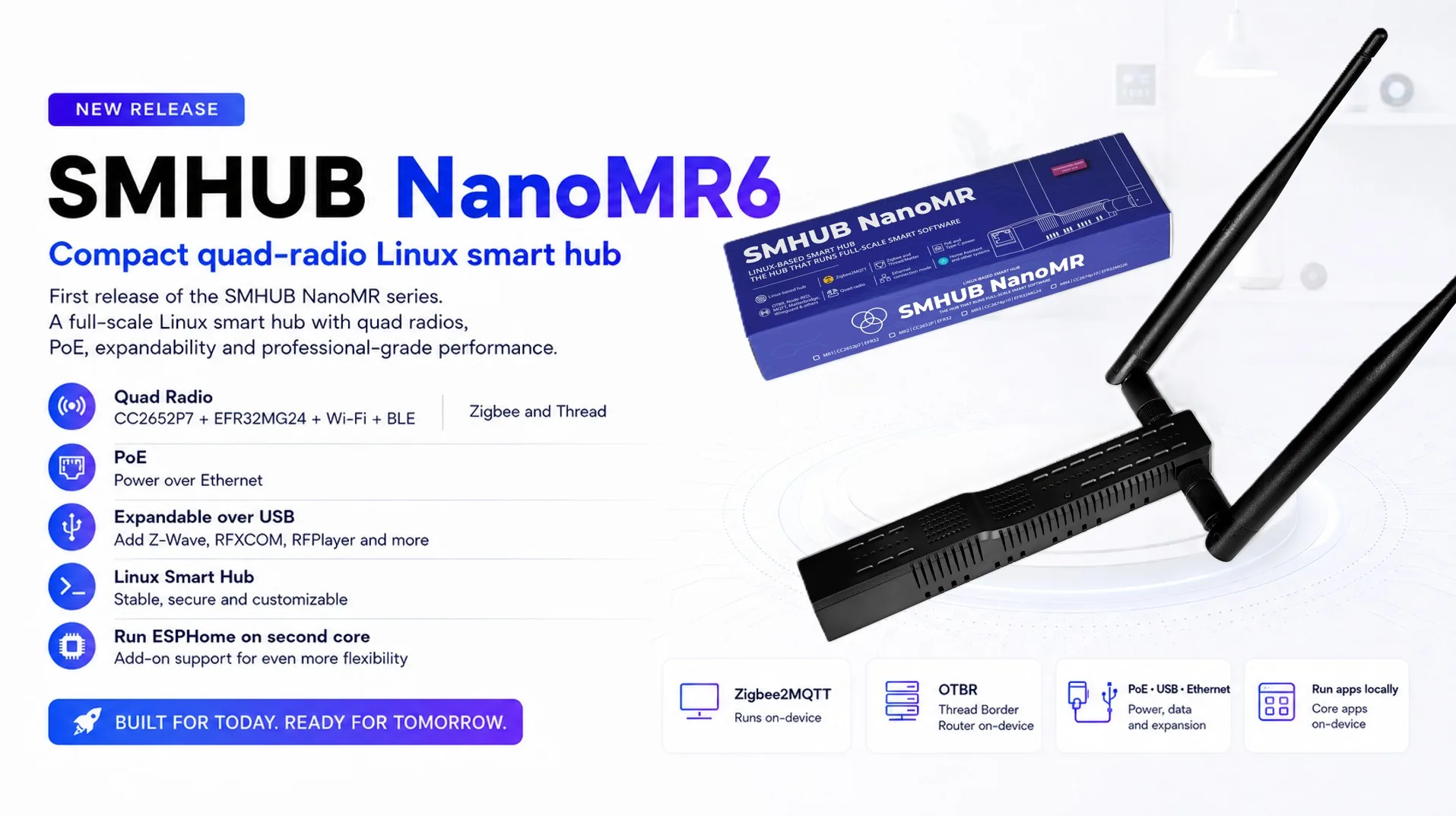
We're pleased to introduce the SMHUB NanoMR6 — the first release of the SMHUB NanoMR series, and a compact quad-radio Linux smart hub.
Quad-radio means four: CC2652P7 and EFR32MG24 for Zigbee and Thread, plus Wi-Fi 6 and Bluetooth. Two independent Zigbee/Thread radios on different silicon — TI's extended-range P7 on one, Silicon Labs' newer MG24, with its extra RAM, flash and Thread 1.3 support, on the other.
Two radios, two networks
The NanoMR is the SMHUB Nano with a second dedicated Zigbee/Thread radio, and that second radio is the point of it. Run two independent networks at once from one compact hub: split a large mesh across two channels, keep a stable network apart from one you are experimenting on, or run Zigbee on one radio and a Thread border router on the other — at the same time.
Because the two radios are different silicon, you can put each network on the stack that suits it rather than compromising on one chip for both.
A real Linux hub, not firmware
This is what separates the NanoMR from a coordinator. It runs SMHUB-OS, a full Linux system where applications are installed, updated and managed from the device's own web interface — Zigbee2MQTT (one instance per radio), Matterbridge, Node-RED, a Mosquitto broker, OTBR as a Thread Border Router, and WireGuard. There is even ESPHome support on the second core.
So it works three ways, and you choose:
- A standalone smart hub — Zigbee2MQTT, a broker and Node-RED on the device itself, with no Home Assistant anywhere.
- A dual-radio coordinator — a dedicated pair of radios for Home Assistant, OpenHAB or HomeSeer, over Ethernet, USB or Wi-Fi.
- Both at once — one radio serving a controller, the other running locally.
Everything stays on your network: no manufacturer account, no cloud dependency, and the web interface, SSH and every application keep working without internet access.
The hardware
| Zigbee / Thread | CC2652P7 + EFR32MG24 — two independent radios |
| Also on board | Wi-Fi 6 (2.4 & 5 GHz) · Bluetooth 5.0 |
| CPU · RAM | Dual core, 1 GHz + 700 MHz · 512 MB |
| Storage | 8 GB eMMC |
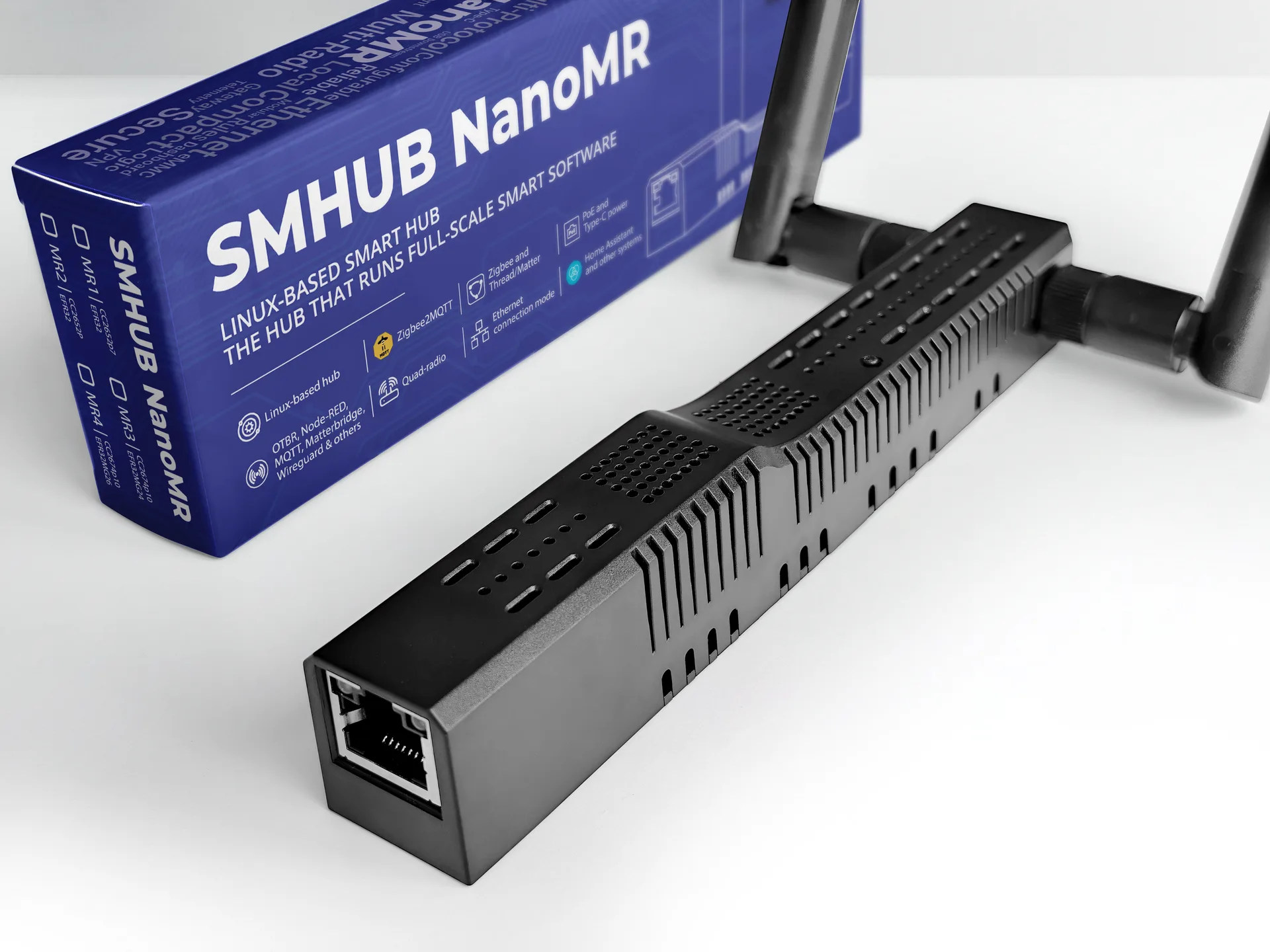
| Network | Ethernet RJ45 10/100 |
| Power | PoE or USB-C |
| Cooling | Fanless — silent, desk or wall mounted |
PoE carries power and data down one cable, so no separate supply is needed. The USB-A port runs in host mode: with a powered hub you can add a Z-Wave dongle and run Z-Wave JS UI locally, an RFXCOM or RFPlayer, a third radio, or a 4G/LTE modem — another protocol entirely, on the same box, without a separate server.
NanoMR or SLZB-MRxU?
Both give you two radios. The difference is what runs on them: the SLZB line runs SLZB-OS, a closed firmware you cannot install applications on, while the NanoMR runs Linux — Zigbee2MQTT, Matterbridge, Node-RED and the rest are real applications you enable, update and manage yourself.
The NanoMR series is designed around the same SoC pairings as that line, and the NanoMR6 — CC2652P7 + EFR32MG24 — is the first of them to ship.
Availability
Shipping now from smartlight.me and from AliExpress — both deliver worldwide, with PoE injectors and a USB-A to Type-C adapter offered alongside it. It reaches our wider distributor network shortly.
The SMHUB NanoMR page has the full picture — the feature diagrams, the photo gallery and the complete specification.