ZeroStack: your coordinator, rebuilt from zero.
New Zigbee firmware for SMLIGHT’s CC-based adapters. Twelve times the traffic of stock TI firmware in our lab, and it never pauses. Same Zigbee2MQTT. Same ZHA. One update, no re-pairing.
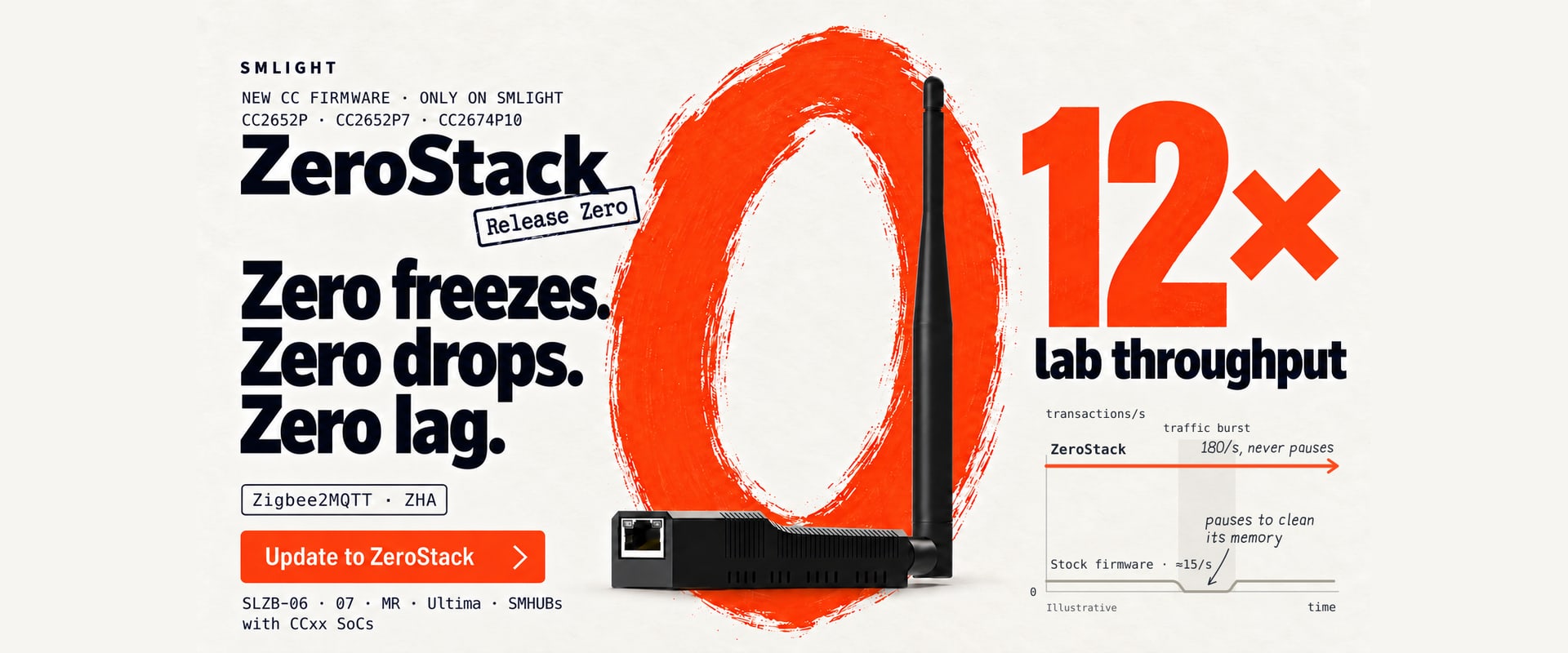
Today we are releasing ZeroStack, Release Zero: a Zigbee coordinator firmware created from scratch for the Texas Instruments radio inside SMLIGHT adapters. It runs on the SLZB-06, SLZB-06p7 and SLZB-06p10 families, the SLZB-07p7 and 07p10 USB sticks, the TI radio in the SLZB-MR series and SLZB-Ultima, and the CC-based SMHUB models. It is designed and signed specifically for SMLIGHT coordinators.
If you have run a large Zigbee network on a CC-based coordinator, you know the symptoms. Zigbee2MQTT logs SRSP - AF - dataRequest after 6000ms. Battery sensors drop off one by one. A restart of Zigbee2MQTT fails with SRSP - SYS - ping after 6000ms until you physically unplug the adapter. The coordinator looks alive, but nothing responds.
We traced every one of these to the same place: the stock Zigbee stack, whose design dates back to radio chips from the early 2000s with a few hundred bytes of memory. Twenty years of patches later, those early decisions are still in the code. Each costs a small stall somewhere between the radio and your hub, and under load the stalls compound into a freeze.
So we rebuilt it. ZeroStack replaces the legacy kernel with FreeRTOS, and the radio’s MAC layer now runs as memory-safe Rust code we wrote ourselves. The coordinator no longer pauses under load. Commands from your hub are never stuck behind sensor reports. The serial link recovers from noise and bursts on its own. Memory stays stable across ten million allocation cycles. Nobody else ships a stack like this on a CC adapter.
Going forward, our efforts go into improving ZeroStack, and each improvement reaches your adapter as an update.
The numbers
Measured in SMLIGHT’s radio lab, same adapter, stock TI firmware versus ZeroStack. One transaction is one command and its confirmation, for example switching a light.
| Stock TI firmware | ZeroStack | |
|---|---|---|
| Sustained traffic | about 15 transactions/s, then it drops to zero | 180 transactions/s and still running (the limit of our test rig, not of the firmware) |
| Coordinator ready after a restart | 4.2 to 6.5 s, often tripping the 6 s timeout | 0.8 s |
| Command round trip under load | 38 to 65 ms, jitter up to 140 ms | 17.5 ms, steady |
| Battery sensors above 32 per coordinator | frames dropped | zero drops, 40+ sleepy devices |
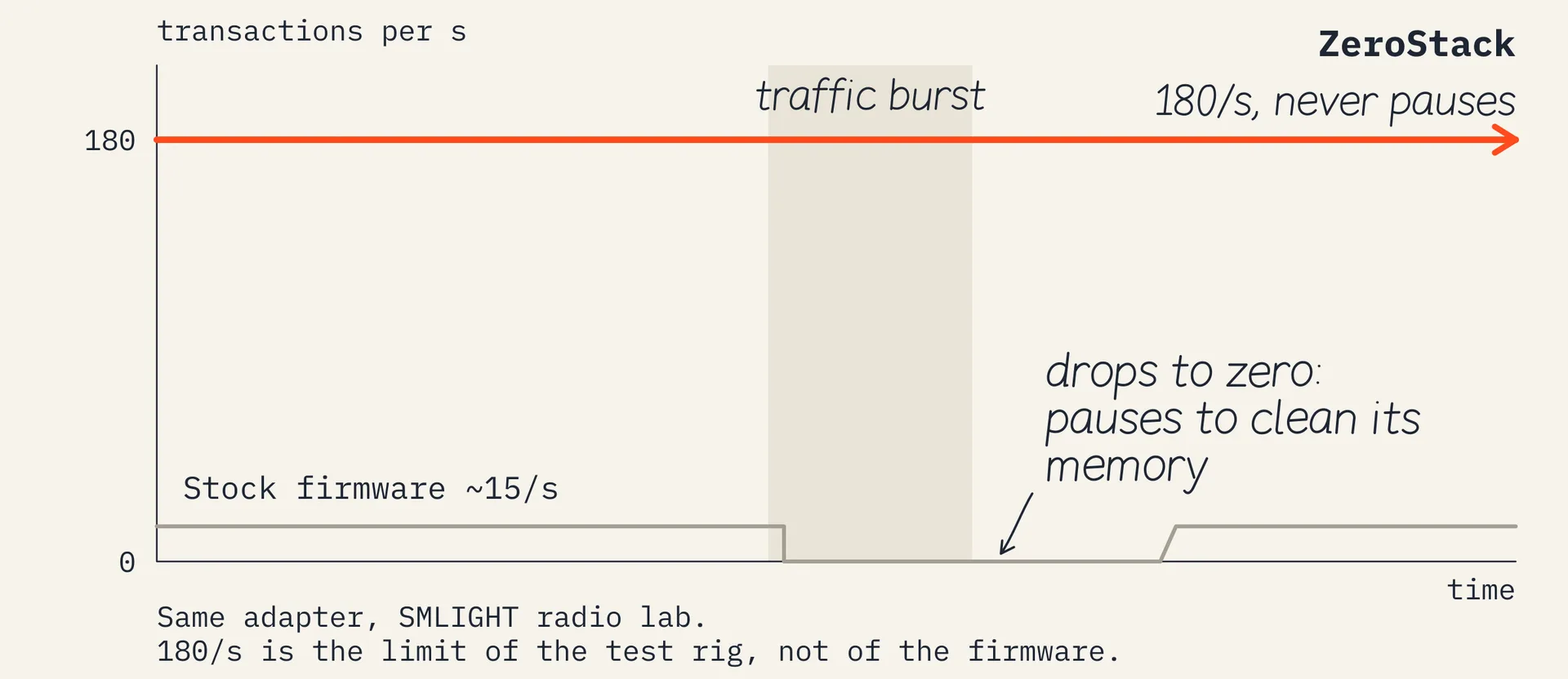 Same adapter, SMLIGHT radio lab. 180/s is the limit of the test rig, not of the firmware.
Nothing changes on your hub
ZeroStack speaks the same Z-Stack protocol as before. Zigbee2MQTT and ZHA see a Z-Stack 3.x coordinator, build 20261109, and need no configuration change. Your paired devices stay paired: after the update, your hub restores its own coordinator backup onto ZeroStack, with the same channel, PAN and keys, so make sure that backup is current. From October 25 to November 10 we moved live Zigbee2MQTT and ZHA networks from stock firmware to ZeroStack and back, build after build, without pairing a single device again.
Get it
ZeroStack Beta 1 is a beta. We recommend a backup of your Zigbee2MQTT or ZHA network before any change, and always before updating to ZeroStack: the update erases the radio, and your hub restores the network from that backup.
Open your adapter’s SLZB-OS web interface, go to Settings and Tools → Firmware update, pick ZeroStack in the Zigbee firmware list and flash. USB adapters flash from the SMLIGHT web flasher in your browser. Stop Zigbee2MQTT or ZHA first, as with any Zigbee firmware update. Five minutes, no cables.
ZeroStack is included for every supported SMLIGHT adapter, designed and signed specifically for SMLIGHT coordinators.
Release Zero ships coordinator and router builds. One build runs at 115200 and 460800 baud and detects the speed by itself. Full details, the compatibility table, the update guide and the engineering notes are on the ZeroStack product page.
One launch, two products. Last week we shipped ZREL, which carries your Zigbee mesh over Ethernet through walls, floors and buildings. ZeroStack makes the coordinator at the heart of that mesh run like new. They are designed to run side by side.
Links
- ZeroStack product page: https://smlight.tech/software/zerostack
- Need help? Open it in Support